What if AI did more than respond to your prompts?
What if it understood how you prefer to work, asked better follow-up questions, adjusted to your pace, and helped you make stronger decisions without taking control away from you?
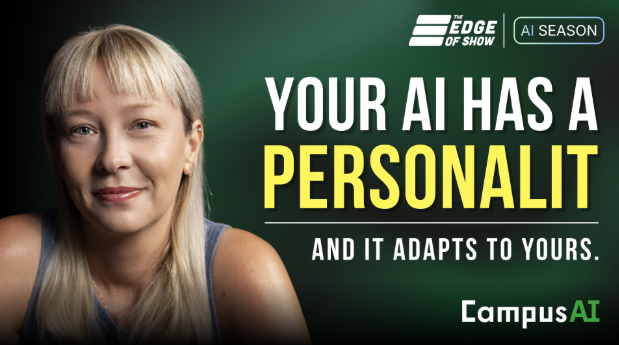
On this episode of Edge of AI, Ron Levy speaks with Aleksandra Przegalinska, an AI scholar, researcher, practitioner, and Campus AI leader, about the rise of collaborative AI. The conversation explores how generative AI can become more personalized, more useful, and more human-centered—while also reshaping education, reskilling, marketing, and the future of work.
For Przegalinska, the most promising version of AI is not a replacement for people. It is a collaborator.
“Artificial intelligence is our tool and should be designed in such a way to serve as a tool for humans,” she says.
What Is Collaborative AI?
Collaborative AI is a design approach that treats artificial intelligence as a partner rather than an autonomous replacement for human work.
Instead of simply receiving a prompt and returning an answer, collaborative systems can help users clarify their goals, improve their prompts, learn from feedback, and work through tasks together.
The concept has roots in robotics. Collaborative robots, or cobots, are designed to work safely alongside people in physical environments. They can adjust to human movements, respond to changing conditions, and support people without removing them from the process.
Przegalinska believes the same principle should guide generative AI.
A well-designed AI system can act as a sparring partner, assistant, tutor, researcher, or specialist—while humans remain responsible for strategic choices and critical decisions.
Human in the Center, Not Just Human in the Loop
The conversation moves beyond the familiar phrase “human in the loop.”
For Przegalinska, the stronger idea is the human in the center. AI can take on routine work, support research, provide feedback, and help people move faster. But decisions that shape a person’s life, organization, or strategy should remain human decisions.
This approach creates a healthier relationship with AI.
Instead of asking whether AI will replace people, the better question is: how can AI help people do better work, make stronger decisions, and use their time more meaningfully?
AI That Prompts You Back
One of Przegalinska’s research experiments involved creating an alternative version of ChatGPT that did not immediately provide an answer.
Instead, the system asked the user clarifying questions. It sought to understand the context of the prompt, identify missing details, and help improve the request before generating an output.
The result was a more collaborative interaction.
Rather than acting like a one-way answer machine, the AI behaved more like a human teammate. It helped users think through what they wanted and refine the task together.
This approach can improve the quality of AI output while also making users more intentional about how they work with generative tools.
Your Personality Shapes How You Use AI
Not everyone collaborates with AI in the same way.
Przegalinska and her research team explored this through personality testing based on the Big Five personality traits. Their work found that people’s personalities can affect how they prefer to work with generative AI assistants.
Some users may want AI to act as a delegate or proxy. Others may want to review and control every part of the process. Some may prefer AI to support creative exploration, while others use it primarily for structure, speed, and routine work.
This insight points toward a future in which AI assistants are not only task-specific but also personalized to an individual’s working style, preferences, and comfort level.
“Patterns of collaboration are so varied,” Przegalinska says.
How Campus AI Is Rethinking AI Education
Campus AI is a learning platform built to help people understand and apply generative artificial intelligence—from the basics of prompting to more advanced, practical use cases.
The platform uses AI throughout the learning experience. Its courses include avatars of real instructors and synthetic AI characters, enabling content to be updated, localized, and delivered at scale.
Campus AI also demonstrates AI through practice. Learners can explore how to generate music, video, images, code, and other creative work using AI tools.
The goal is not only to explain how AI works, but to help users feel capable of using it themselves.
Przegalinska says AI education is especially important because the rise of generative AI has created both excitement and information chaos. High-quality learning can help people move past fear, understand the technology’s limits, and develop practical skills.
Personalized Reskilling With AI Tutors
One of Campus AI’s most ambitious concepts is its AI Gym: a space for reskilling and career development.
The idea is to use AI tutors and agents to help learners evaluate their existing experience, identify possible career paths, and choose a learning plan that fits their goals.
The AI tutor can monitor progress, suggest changes in pace, and recommend a different reskilling strategy when necessary. Rather than issuing instructions from above, it enters into a dialogue with the learner.
This is especially valuable as organizations and individuals face rapid change in the workplace. Businesses need flexible ways to help teams develop new skills without requiring everyone to return to traditional full-time education.
AI, Education, and the Future of Work
Generative AI is forcing education to change.
Traditional systems often reward students for memorizing information or producing standard essays and assignments. But when AI can generate a response in seconds, the value of education must move beyond simply finding the answer.
Przegalinska sees an opportunity to use AI for more personalized teaching. Educators can present the same concept in different ways to different learners, adapt materials to different needs, and help students build stronger thinking skills.
Campus AI does not aim to replace schools or universities. Instead, it aims to partner with institutions, organizations, and individuals as they navigate new models of AI-assisted learning.
Its strategy combines two paths:
- A B2B playground where organizations can reskill teams, prototype with AI, and explore new use cases.
- A B2C learning community where individuals can build skills, create projects, and grow with the platform.
AI Should Support Human Flourishing
The conversation returns repeatedly to a simple principle: AI should make people more capable, not less human.
Whether through a better AI tutor, a personalized assistant, or an agent that helps someone research and create, the technology should support people’s goals, well-being, and creativity.
And sometimes, the best balance is to step away from the screen entirely.
Przegalinska recommends “forest bathing”—spending unstructured time in nature, breathing, walking, and reconnecting with the physical world.
As AI becomes more present in daily life, that human balance may become even more valuable.
Key Topics Covered
- What collaborative AI means in practice
- Why AI should support humans instead of replacing them
- Personalized AI agents and personality-based collaboration
- AI that asks clarifying questions before generating an answer
- Campus AI’s approach to generative AI education
- AI avatars, synthetic instructors, and scalable learning
- The role of AI tutors in reskilling and career development
- How AI can help organizations prototype and innovate
- Why education must teach people how to think, not just what to answer
- The importance of human judgment, relationships, and time in nature
Episode Highlights
“Artificial intelligence is our tool and should be designed in such a way to serve as a tool for humans.” — Aleksandra Przegalinska
“Human in the center” means keeping crucial decisions with people while AI assists their work. — Aleksandra Przegalinska
“Patterns of collaboration are so varied.” — Aleksandra Przegalinska
“We want the platform itself to personalize itself according to your preferences.” — Aleksandra Przegalinska
“Forest bathing is something I would recommend to anyone.” — Aleksandra Przegalinska
People and Resources Mentioned
- Aleksandra Przegalinska
- Ron Levy
- Campus AI
- ChatGPT
- Perplexity
- Hard Fork podcast
- Max Tegmark
- MIT Media Lab
- Harvard’s Center for Labor and a Just Economy
- The Big Five personality test
- Generative AI
- Collaborative AI
- AI agents
- AI avatars
About Our Guest
Aleksandra Przegalinska is an AI scholar, researcher, and practitioner focused on human-machine interaction, natural language processing, collaborative AI, and the future of work. She is a leader at Campus AI, an AI education platform helping individuals and organizations develop practical generative AI skills. Her work explores how artificial intelligence can become more personalized, collaborative, and supportive of human capabilities.
Learn more about Campus AI at campus.ai
Listen to the Full Episode
Follow Edge of AI for conversations with the researchers, entrepreneurs, and operators shaping the future of artificial intelligence.
Visit edgeofai.xyz to learn more about partnering with Edge of AI and to subscribe to the Outer Edge newsletter.