What separates an impressive AI tool from a genuinely intelligent machine?
On this episode of Edge of AI, Ron Levy speaks with Peter Voss, an artificial intelligence pioneer who coined the term Artificial General Intelligence, or AGI, in 2001. Voss explains why today’s most powerful large language models are not yet true AGI—and why the next major shift in AI may come from systems that can learn, reason, remember, and adapt more like humans.
Voss is the founder of Aigo.ai, a cognitive AI company working toward human-level artificial intelligence. His perspective challenges the idea that scaling data and computing power alone will produce truly general intelligence.
“ChatGPT has given us a taste of AGI,” Voss says. “It seems so close in some ways, and yet it’s so far.”
What Is Artificial General Intelligence?
Traditional AI has largely focused on narrow tasks: solving a specific problem, recognizing images, translating a language, optimizing logistics, or playing chess.
According to Voss, those systems can be powerful, but their intelligence is largely external. Engineers, programmers, and data scientists design the task, select the data, tune the model, and determine the conditions under which it operates.
AGI is different.
Artificial General Intelligence refers to a system that can learn interactively, reason across domains, apply knowledge in new contexts, and build understanding over time. Rather than being trained to perform one class of task, an AGI system would develop adaptable, general-purpose intelligence.
Voss describes this as a return to the original dream of AI: building thinking machines.
AGI vs. Large Language Models
Large language models such as ChatGPT can summarize information, write content, assist with code, translate language, and hold natural conversations. Their broad capabilities have brought AI into public view at an unprecedented scale.
But Voss argues that LLMs are still limited by their core architecture.
They require enormous training datasets, substantial tuning, carefully designed prompts, and human oversight. They can also generate false or unreliable information, often called hallucinations.
“GPT” stands for generative pre-trained transformer, Voss notes. “So it does make up stuff. It’s not reliable.”
For Voss, the challenge is not simply to create a model that produces convincing answers. It is to create an AI that understands concepts, learns in real time, keeps track of knowledge sources, and can evaluate whether information is accurate.
He believes LLMs may be useful tools for an AGI system—for example, to extract or compare information—but should not become the core architecture of human-level AI.
The Three Waves of AI
Voss points to a framework from DARPA that describes AI’s evolution in three waves.
The first wave was symbolic or rule-based AI. These early systems relied on explicit logic, programmed rules, and structured knowledge.
The second wave is statistical AI, including neural networks and large-scale machine learning. This approach has driven major progress in image recognition, speech recognition, translation, and natural-language interfaces.
The third wave, according to Voss, is cognitive AI: systems that can adapt in real time, reason about what they are doing, learn incrementally, and operate in changing circumstances.
This third wave is where Voss sees the path to AGI.
Why Human Learning Is a Better Model
One of Voss’s core arguments is that human intelligence is far more energy-efficient and data-efficient than current AI systems.
A child learns language and develops basic reasoning skills from a relatively limited number of interactions. By contrast, large language models are trained on trillions of tokens and require significant computing resources.
The human brain, he notes, operates on roughly 20 watts of power.
Voss believes an AGI should learn more like a child: beginning with foundational concepts, building understanding interactively, and then using those concepts to acquire more advanced knowledge.
“Once you have 200 words, you can then already use it to bootstrap and start to learn the next 200,” he says.
The goal is not to brute-force intelligence through more data. It is to develop the right cognitive architecture.
Aigo and Cognitive AI in Practice
Aigo was formed after Voss’s earlier AI company, Smart Action, developed technology for call center automation.
Unlike traditional call center systems that rely on rigid flowcharts, Aigo uses a cognitive AI approach designed to support memory, reasoning, and more natural conversation. The system can retain context from earlier in a conversation and, depending on a company’s implementation and security requirements, maintain long-term information across customer interactions.
Aigo’s technology was used in call center automation, including a deployment that handled thousands of agents’ worth of demand during a major Valentine’s Day period for the 1-800-Flowers and Harry & David group of companies.
But Voss says the company has chosen to focus more directly on the larger goal: reaching human-level AGI.
Commercial systems often require narrow rules, business-specific knowledge, and extensive implementation work. While that can create a useful product, it is different from building a general intelligence system from the ground up.
Where AGI Could Have the Greatest Impact
Voss sees three major areas where AGI could create enormous value.
The first is scientific research. An AGI trained to a PhD-level standard in cancer research, battery technology, energy, or nanotechnology could potentially be replicated and deployed at scale. Such systems could review vast research libraries, identify patterns across studies, test hypotheses, and share discoveries without the bottlenecks of human time, memory, or institutional silos.
The second is knowledge work. AGI could eventually reduce the cost of many desk-based services by assisting with complex reasoning, problem-solving, analysis, and operational work.
The third is the personal assistant. Voss imagines a “personal, personal, personal assistant” in three senses:
- It is owned by the individual and serves their interests.
- It is deeply personalized to their goals, history, and relationships.
- It protects the individual’s privacy by allowing them to control what information is shared.
He describes this future assistant as “a little angel on your shoulder” that can help people think through decisions, solve problems, and flourish.
The Role of Metacognition
For Voss, a key ingredient of human-level intelligence is metacognition: the ability to think about one’s own thinking.
His research into philosophy, cognitive psychology, and computer science led him to see concept formation and metacognition as essential to AGI. Humans can create concepts on top of concepts, moving from concrete observations to abstract ideas such as government, honor, ethics, and identity.
An AI that can reason about its own knowledge, confidence, learning process, and sources of information may be better positioned to operate reliably in complex environments.
When Will We Reach AGI?
Predictions about AGI vary widely. Some experts argue it is decades away. Others claim it already exists in an early form.
Voss does not believe true AGI exists today. However, he believes the required computing power may already be available or will be available soon. In his view, the main constraint is not hardware—it is the need for the right cognitive design and more investment in that direction.
With the right funding, partnerships, and technical progress, Voss believes human-level AGI could be possible within two to three years. That is his forecast, not a certainty.
Key Topics Covered
- The difference between narrow AI, LLMs, and AGI
- Why Peter Voss coined the term Artificial General Intelligence
- The three waves of AI: symbolic, statistical, and cognitive
- Why LLMs can be powerful but unreliable
- How cognitive AI learns, remembers, and reasons
- Aigo’s approach to call center automation
- Why human learning is more data-efficient than current AI training
- How AGI could accelerate scientific research
- The future of personal AI assistants
- The importance of metacognition, concept formation, and human reasoning
Episode Highlights
“AGI is to have machines that can learn like a human.” — Peter Voss
“ChatGPT has given us a taste of AGI. It seems so close in some ways, and yet it’s so far.” — Peter Voss
“The limiting factor is using the right technology, using the right approach.” — Peter Voss
“We should be able to build human-level intelligence much closer to the 20 watts that our brain uses.” — Peter Voss
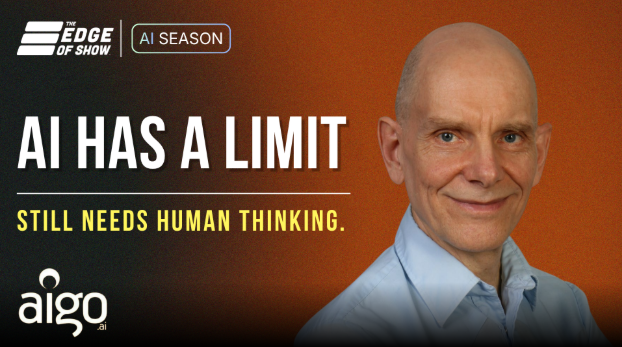
“AI has tremendous potential, but it still needs human thinking.” — Peter Voss
People and Resources Mentioned
- Peter Voss
- Ron Levy
- Aigo.ai
- Smart Action
- ChatGPT
- Large language models
- DARPA
- Jan LeCun
- Meta
- Elon Musk
- 1-800-Flowers
- Harry & David
- Artificial General Intelligence Conference
About Our Guest
Peter Voss is an AI pioneer, engineer, scientist, and inventor who coined the term Artificial General Intelligence in 2001. He is the founder of Aigo.ai, a company developing cognitive AI systems designed to learn, reason, and adapt in real time. Voss previously founded Smart Action, an AI-powered call center automation company, and has spent more than two decades researching and developing approaches to human-level machine intelligence.
Learn more about Peter Voss and Aigo at aigo.ai.
Listen to the Full Episode
Follow Edge of AI for conversations with the founders, researchers, and operators shaping the future of artificial intelligence. Visit edgeofai.xyz to learn more about Edge of AI, partnerships, and the latest updates from Edge of Company.